Pathfinder 2e and D&D 5E attract the same players and still split tables down the middle. Both are d20 fantasy games with classes, spells, monsters and loot. They don't feel the same at the table.
D&D 5E is easier to start and easier to improvise. Pathfinder 2e is more structured, more tactical and more precise. Neither is better; they solve different problems. This guide shows where the difference lives, with the maths worked out, so your group can pick with its eyes open.
Editions compared: D&D's 2024 rules as published in the SRD 5.2.1 [1], and Pathfinder's Remaster rules (Player Core and GM Core, released November 2023 [2]), as hosted on Archives of Nethys [3]. Odds come from a Python script counting every d20 outcome.
The short answer
| Your group wants... | Better fit |
|---|---|
| Fast onboarding | D&D 5E |
| More tactical combat | Pathfinder 2e |
| Name recognition and easy recruiting | D&D 5E |
| Tighter encounter maths | Pathfinder 2e |
| More mechanical character choices | Pathfinder 2e |
| Easier casual play | D&D 5E |
| More written rules for edge cases | Pathfinder 2e |
| More DM flexibility | D&D 5E |
| A lighter rules burden | D&D 5E |
If your table likes loose rulings, 5E. If it likes crunchy decisions and clear structure, Pathfinder.
Core dice: same d20, different ladder
Both games roll a d20, add a number, and compare it to a target: a Difficulty Class, Armor Class or save DC.
In D&D 5E the number is an ability modifier plus a proficiency bonus that tops out at +6 [1, "Playing the Game"]. In Pathfinder 2e, proficiency adds your level: trained is level + 2, expert level + 4, master level + 6, legendary level + 8 [3, "Step 9: Calculate Modifiers", Player Core p. 25]. A level 15 Pathfinder character adds 17 or more to a trained skill. That's why level gaps in Pathfinder hurt: a monster four levels above you isn't a bit tougher, it's in a different weight class.
Bonuses: advantage vs typed modifiers
D&D 5E folds most situational help into advantage and disadvantage: roll two d20s, keep the higher or lower. Advantage doesn't stack: two sources of it still mean one extra d20 [1, "Advantage/Disadvantage"]. Quick to run, hard to argue about.
Pathfinder 2e uses typed bonuses and penalties: circumstance, item and status. Of each type you take only the best bonus and the worst penalty; untyped penalties, like the multiple attack penalty, all add together [3, "Penalties", Player Core p. 400].
That sounds fussy, and at 11pm it is. The payoff is precision: two allies on opposite sides of a foe make it off-guard, a clean −2 circumstance penalty to its AC [3, "Flanking", Player Core p. 425]. Small, exact, and it stacks with everything of a different type.
Four degrees of success
Pathfinder's biggest difference. Beat the DC by 10 or more and you critically succeed; miss by 10 or more and you critically fail. A natural 20 moves the result one step up, a natural 1 one step down [3, "Degree of Success", Player Core p. 401]. A critical Strike deals double damage [3, "Strike"].
In D&D 5E, most rolls ask "did it work?" In Pathfinder the question is "how well?" A basic saving throw has four outcomes: no damage, half, full or double.
In Pathfinder, a natural 1 isn't just a failure. It's a failure with its own subsection.
Here's what that does to a single attack. A +9 attack bonus against AC 16:
| Attack | Critical hit | Hit | Miss | Critical miss |
|---|---|---|---|---|
| 1st Strike, +9 | 20% | 50% | 25% | 5% |
| 1st Strike, +10 (a +1 bonus) | 25% | 50% | 20% | 5% |
| 1st Strike vs flanked target (AC 14) | 30% | 50% | 15% | 5% |
A +1 bonus in 5E adds 5% to your hit chance and nothing else. In Pathfinder the same +1 also moves 5% of your hits up to crits, and crits double damage. Flanking alone takes the crit rate from one in five to nearly one in three. Pathfinder players fuss over +1s because a +1 is worth fussing over.
Action economy: three actions vs action, bonus action, move
D&D 5E gives you movement up to your Speed, one action, a Bonus Action if a feature grants one, and a reaction [1, "Your Turn"; "Bonus Actions"]. It works. New players still ask "is drawing my sword a bonus action?" about once a session.
Pathfinder 2e gives you three actions and one reaction every turn [3, "Start Your Turn", Player Core p. 435]. Stride costs one. A Strike costs one. Raise a Shield costs one [3, "Raise a Shield", Player Core p. 419]. Many spells cost two. A turn becomes a small puzzle:
- Stride, Strike, Raise a Shield.
- Strike, Strike, Step back.
- Cast a two-action spell, then Stride.
- Demoralize, Strike, Stride.
The catch is the multiple attack penalty: your second attack in a turn takes −5, your third −10 (−4 and −8 with an agile weapon) [3, "Multiple Attack Penalty", Player Core p. 402]. Same +9 fighter, AC 16:
| Strike | Bonus | Critical hit | Hit | Miss | Critical miss |
|---|---|---|---|---|---|
| 1st | +9 | 20% | 50% | 25% | 5% |
| 2nd | +4 | 5% | 40% | 45% | 10% |
| 3rd | −1 | 5% | 15% | 45% | 35% |
With a 1d8 + 4 weapon (average 8.5, crits doubled), the first two Strikes average 11.9 damage between them. The third adds only 2.1 (it mostly hits the air, which has surprisingly good AC). That's the design: your third action is usually worth more spent on moving, shielding or setting up an ally than on swinging again. 5E rarely asks that question. Pathfinder asks it every turn.
Character creation
D&D 5E: choose a class, then an origin (background, species, two languages), then ability scores and alignment [1, "Character Creation"]. A Champion fighter takes ten minutes. A wizard takes longer.
Pathfinder 2e: ancestry, then a heritage within it and an ancestry feat, then background, class and attribute modifiers [3, "Step 3: Select an Ancestry"; "Step 5: Choose a Class"]. After that comes a steady stream of feats as you level: ancestry, class, skill and general feats, with archetypes on top. Players who love building characters light up. Players who want to sit down and hit things glaze over.
Encounter building
Both games budget encounters with XP. D&D's 2024 rules give an XP budget per character at Low, Moderate and High difficulty; a party of four level 3 characters gets 900 XP for a Moderate fight [1, "Combat Encounters"]. Pathfinder's GM Core gives a flat budget for four characters: 40 trivial, 60 low, 80 moderate, 120 severe, 160 extreme, plus or minus a set amount per extra or missing character [3, "XP Budget", GM Core p. 75]. Monsters cost XP by level relative to the party: a creature at party level costs 40, and one four levels above costs 160, the whole extreme budget on its own [3, "Choosing Creatures", GM Core p. 76].
The difference is how well the numbers hold. Because Pathfinder's maths is tight, level gaps and bonuses behave predictably, and the budget tends to deliver the fight it promised. In 5E, magic items, rests, party make-up and one well-timed control spell swing results wildly; many DMs learn to treat the budget as a first guess. That's opinion, not rule.
GM workload
D&D 5E asks for more judgement calls. When the rules are loose, the DM decides more things, and that invisible work adds up.
Pathfinder 2e asks for more rules fluency. Conditions, actions, DCs and treasure all have written guidance. You look things up more; you invent less.
Neither is effortless. They tire you out in different places.
Tactical depth and balance
Pathfinder punishes standing still. Positioning, conditions and teamwork matter, as the flanking table shows. In 5E, a character can stand in one place using their best action every round and still pull their weight.
Pathfinder also keeps classes closer together. Optimisation exists, but one build rarely leaves the table behind. 5E's power curve is looser; some tables enjoy the chaos of a wizard who solves everything. Pick your chaos.
Learning curve
The 5E pitch to a new player: "Roll a d20, add a number, try to beat the target."
The Pathfinder pitch: "You have three actions, bonuses have types, proficiency scales with level, success has four degrees, and your abilities have traits."
Pathfinder isn't impossibly hard. The first few sessions just ask more of everyone. For a casual table with patchy attendance, 5E. For a committed table that enjoys learning a system, Pathfinder pays that effort back.
Which suits beginners?
It depends on the beginner. A casual newcomer usually settles into 5E faster. A board game or strategy game player often loves Pathfinder, because every option is on the page and nothing depends on guessing what the DM will allow. A whole table learning together, with a prepared GM, can start with either.
Which suits roleplay?
Neither owns it. A roleplay-heavy group can run a brilliant campaign in both. 5E leaves more room for loose rulings. Pathfinder defines what characters can do in clearer terms, which some players find freeing. The table matters more than the system.
Final verdict
D&D 5E suits groups that want to get playing tonight: accessible, flexible, familiar.
Pathfinder 2e suits groups that want tactical play, dependable encounter maths, deep builds, and a rulebook that answers the question before anyone argues about it.
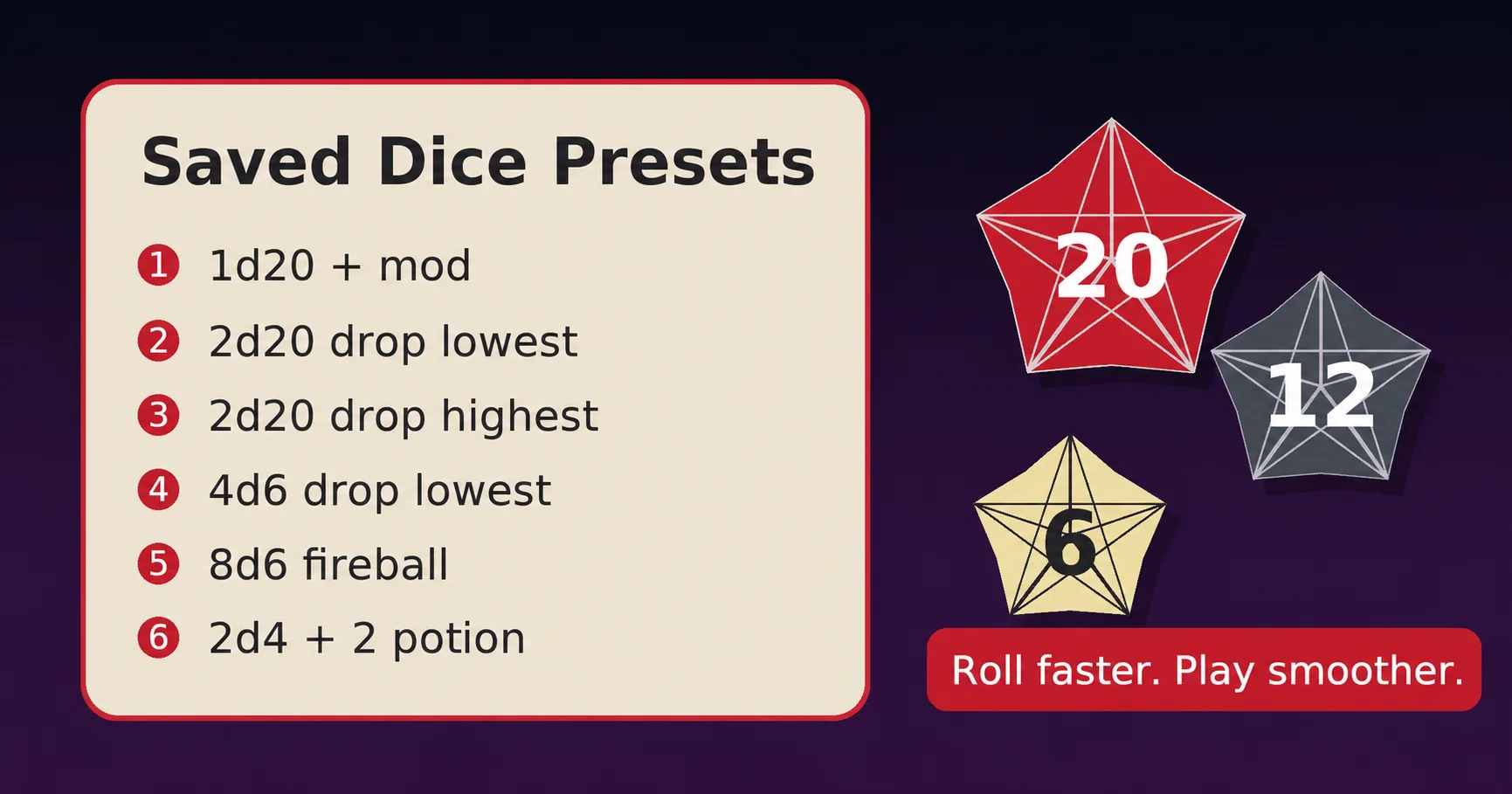
The best system isn't the one with the loudest fans. It's the one your table will play every week. Whichever you pick, the dice are the same: the roller handles d20s, damage and advantage, and the 3D table makes them tumble.
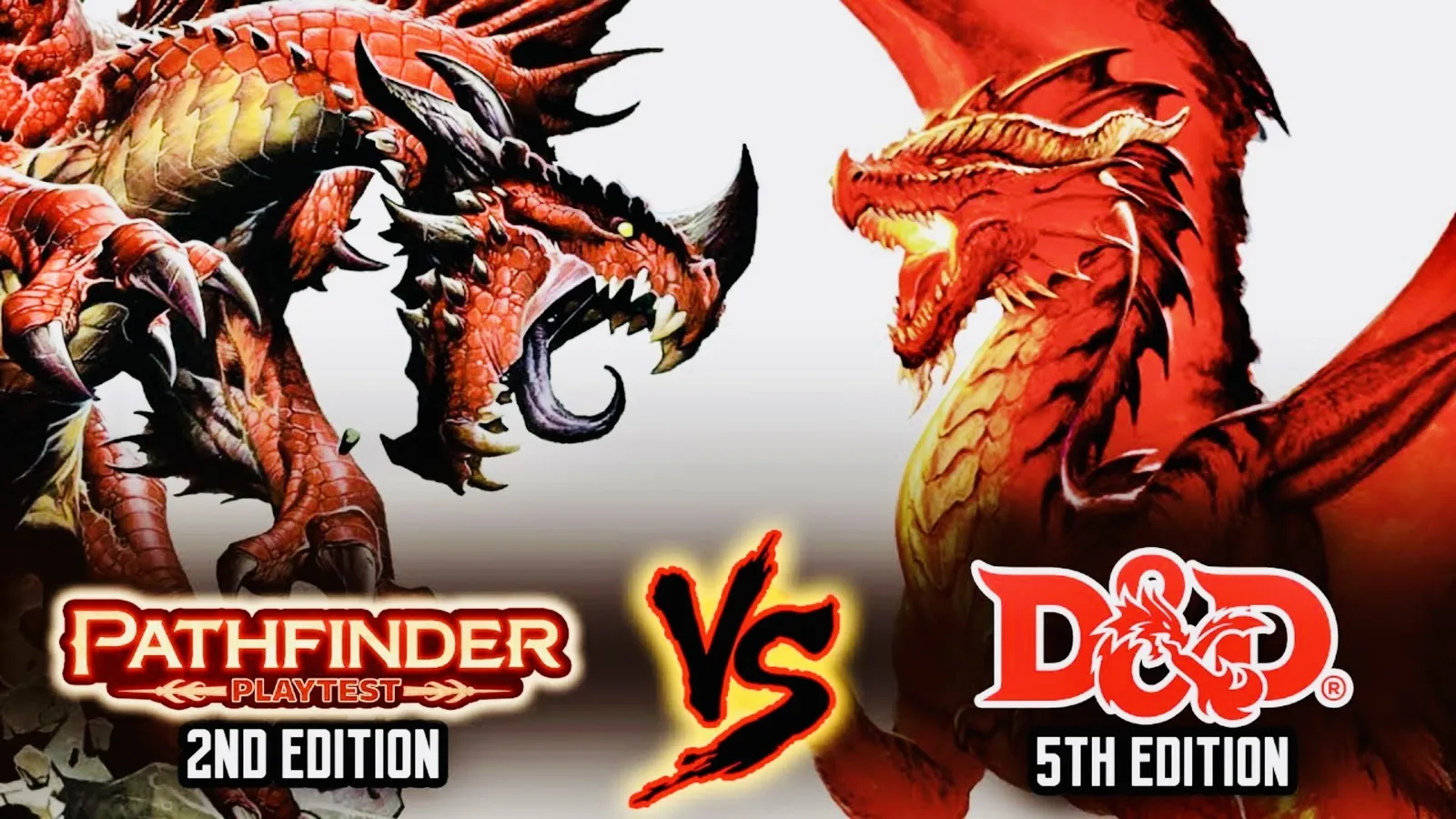
Pathfinder is a trademark of Paizo Inc. D&D is a trademark of Wizards of the Coast LLC. The header image uses both for comparison.
Table Talk
Rohan: The numbers say it. Third Strike adds 2.1 damage. Stop swinging.
Arthur: Agreed. Stride, Strike, Raise a Shield.
Rohan: In 5E I'd stand there, hit things and still pull my weight.
Arthur: That's the point of 5E. Quick start, loose rules, the DM makes the call.
Rohan: And the DM gets tired making calls.
Arthur: Pathfinder GMs get tired looking things up. Pick where you want to be tired.
Rohan: Flanking takes the crit rate from one in five to three in ten. Worth the page flip.
Arthur: Tip for Pathfinder: save your first, second and third Strike as separate roller lines. The minus five shouldn't depend on memory at 11pm.
Rohan: Or on the fighter's memory at any hour.
References
- Wizards of the Coast. (2025). System Reference Document 5.2.1 (SRD 5.2.1), sections "Playing the Game", "Character Creation" and "Gameplay Toolbox: Combat Encounters". CC-BY-4.0. https://www.dndbeyond.com/srd
- Paizo Inc. (2023). Pathfinder Second Edition Remaster Core Preview (Player Core and GM Core, released November 2023). https://paizo.com/pathfinder/corepreview
- Archives of Nethys. (n.d.). Pathfinder 2nd Edition rules database, citing Paizo's Player Core (2023): "Penalties" p. 400, "Step 4: Degree of Success" p. 401, "Multiple Attack Penalty" p. 402, "Strike", "Step 3: Select an Ancestry", "Step 5: Choose a Class", "Step 9: Calculate Modifiers" p. 25, "Raise a Shield" p. 419, "Flanking" p. 425, "Step 1: Start Your Turn" p. 435; and GM Core (2023): "XP Budget" p. 75, "Choosing Creatures" p. 76. https://2e.aonprd.com/