Dungeons & Dragons is the default front door to fantasy roleplaying, and for good reason: it's everywhere, and finding players is easy. But "most popular" isn't "best for every group."
Groups go looking for something else when they want one of four things: deeper tactical combat, faster and deadlier dungeon crawls, a gentler and more structured start for young or neurodivergent players, or simply a game whose strengths match how the table already plays. You don't have to leave fantasy behind. You have to know which problem you're solving.
The short version
| If your group wants... | Best fit |
|---|---|
| Tactical depth and character build choices | Pathfinder 2e |
| A structured, supportive introduction for young or autistic players | Critical Core |
| Fast, dangerous, old-school dungeon crawling with modern clarity | Shadowdark |
| Familiarity and the easiest time finding players | D&D |
None of these is objectively better. They're better at different things.
At a glance
| D&D (2024) | Pathfinder 2e | Critical Core | Shadowdark | |
|---|---|---|---|---|
| Publisher | Wizards of the Coast | Paizo | Game to Grow (now STAR Institute) | The Arcane Library |
| Core die | d20 | d20 | Built on the Open Game Licence | d20, roll high |
| Ability scores | Array, point buy or 4d6 drop lowest | Attribute modifiers from ancestry, background, class [2] | Ready-made characters and sheets | 3d6 in order |
| Turn structure | Move, action, bonus action, reaction | Three actions, one reaction | — | Always-on initiative; distances are close, near, far |
| Signature idea | Advantage/disadvantage | Four degrees of success | Therapeutic facilitator guidance | Darkness and torchlight as danger |
| Try it free | SRD 5.2.1 | Archives of Nethys rules site | — | Quickstart Set |
Sources for each row are in the sections below.
Why people look beyond D&D
D&D does a lot well: heroic fantasy, a huge player base, and a mountain of published support. It also has trade-offs. Some groups find that:
- combat runs slower than they'd like
- characters grow powerful fast, so danger gets hard to maintain
- the rules aren't as tactically tight as they want
- the game asks for a style of play that doesn't suit kids, beginners, or players with specific support needs
- they want more tension, more simplicity, or less build sprawl
People rarely reject fantasy adventure. They're looking for a system that fits their table. (Nobody has ever quit D&D because there were too many dragons.)
Pathfinder 2e
The best-known answer for players who want more mechanical precision and more meaningful choices each turn.
What it does well
Pathfinder 2e gives every character three actions and one reaction a turn [3], so every turn is a small puzzle: attack twice, or attack, step back and raise a shield? Beat a DC by 10 and you critically succeed; miss by 10 and you critically fail [3]. That makes every +1 matter. Against AC 16, a +9 attack crits 20% of the time; flank the target (a −2 penalty to its AC) and that jumps to 30% [3]. (We did the full maths in Pathfinder 2e vs D&D 5E.)
It rewards system mastery. If your players enjoy planning feats, class options and party roles, Pathfinder gives them a lot to chew on. The current Remaster core books, Player Core and GM Core, came out in November 2023 [4].
Where it's weaker
- higher rules load
- more reading during character creation
- more moving parts to track
- a steeper start for casual players
If your table still mixes up saving throws, attack rolls and skill checks, Pathfinder adds weight instead of solving a problem.
Best for
- tactically minded groups
- players who enjoy crunchy character options
- tables that want rules to answer questions before anyone argues about them
Critical Core
A different kind of alternative. It isn't trying to out-crunch D&D or out-kill old-school crawlers. It was built for a purpose: helping young people, especially autistic teens, build social skills through roleplaying, with a trained facilitator running the table.
What it is
Critical Core comes from Game to Grow, a nonprofit founded in 2017. Its team, Adam Davis, Adam Johns and Virginia Spielmann, presented it in 2018 as a way to help "teens and adolescents build social skills, especially when the participants are struggling with challenges related to autism diagnoses" [5]. Game to Grow calls it a therapeutic RPG "beginner's box", and says it has been distributed to over seven thousand therapists, educators and families [6]. It was built under the Open Game Licence, so it will feel familiar to anyone who knows D&D [7].
One change matters if you're buying today. In 2025 Game to Grow announced it was winding down as a nonprofit, and its programs, including Critical Core training, moved to the STAR Institute for Sensory Processing [6].
What it does well
- a friendlier on-ramp for beginners
- guided, supportive structure for players and for the adult running the game
- a clear therapeutic and educational design intent
- material written for facilitators, not only for GMs
A 2022 TTRPGkids review praised it as "easier to understand than other TTRPG's of its size," with clear diagrams and examples [8]. One middle-school counsellor paired up with the school's speech-language pathologist to run it with social-pragmatics students, "primarily with autism learning profiles" [9].
Pathfinder and Shadowdark are hobbyist alternatives. Critical Core is closer to a facilitation tool that happens to be a tabletop RPG.
Where it's weaker
It isn't the right fit if your group wants:
- deep tactical combat
- a big optimisation game
- a lethal old-school crawl
- a large community of players to recruit from
It's specialised. That's its strength and its limit. A table of veterans after brutal hexcrawls or elaborate builds should look elsewhere.
Best for
- kids and families
- therapy, school and library settings
- autistic players, and others who benefit from a structured introduction
- groups that value social development as much as traditional RPG challenge
Shadowdark
For players who love the feel of old dungeon crawls but not the archaic presentation. Its publisher sums it up as "old-school gaming, modernized" [10].
What it does well
Shadowdark, from The Arcane Library, raised $1.3 million on Kickstarter and won the 2024 Three Castles Award for game design, plus four gold ENNIEs: Product of the Year, Best Game, Best Rules, and Best Layout & Design [10]. The design choices behind that:
- d20, roll high, advantage and disadvantage, no skills: just ability checks [10]
- ability scores rolled 3d6 in order [10]
- no darkvision, so total darkness is genuinely dangerous [10]
- low hit points and fast, deadly combat [10]
- roll-to-cast spells, so magic can fail [10]
- gear slots instead of weight tracking [10]
- treasure grants XP [10]
That 3d6-in-order rule is where the danger starts, before anyone enters a dungeon. Here's how it compares with D&D's 4d6 drop lowest, counting every combination:
| Chance of... | 3d6 in order (Shadowdark) | 4d6 drop lowest (D&D) |
|---|---|---|
| A single score of 14+ | 16.2% | 35.5% |
| A character with no score of 14+ | 34.6% | 7.2% |
| A character with at least one score of 8 or less | 83.5% | 48.6% |
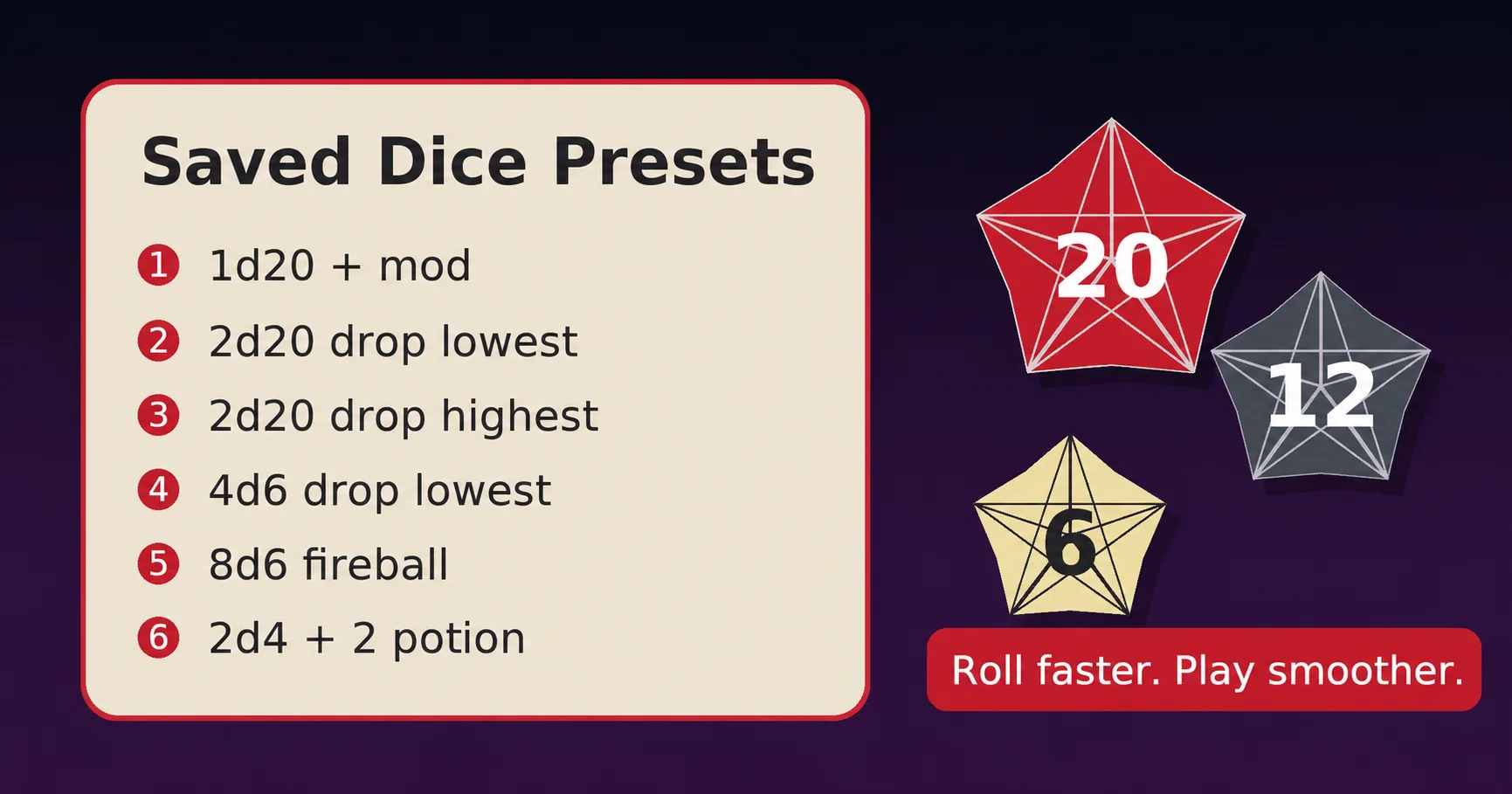
A third of Shadowdark characters have nothing above 13. That's not a bug; it's the point. Your fighter is a desperate person with a torch, and the stories come from how they survive. Try it on the roller: set a 3d6 line, press ++ five times, and hit ALL.
If D&D sometimes feels padded or forgiving, Shadowdark feels sharp. Light matters. Supplies matter. Characters die.
Shadowdark packing list: one torch, one spare torch, one spare character.
Where it's weaker
It isn't ideal if your group wants:
- detailed character builds
- long menus of powers and feats
- a safe, heroic tone
- characters who start as durable action heroes
Some groups love danger and uncertainty. Others hate it. Shadowdark works when the table wants tension, not comfort.
Best for
- old-school dungeon crawling
- groups that want quick play and real danger
- players who want fewer rules but strong atmosphere
- 5E players curious about old-school play: the free Quickstart Set has two 68-page booklets, eight pregenerated characters and a starter dungeon [11]
So which one?
Stay with D&D if:
- you want the easiest time finding players
- your table already knows the rules
- you like heroic fantasy and don't feel limited by the system
Its free core rules live in the SRD 5.2.1 [1], and the spells and monsters are on this site at /spells/ and /monsters/.
Choose Pathfinder 2e if:
- your group wants tactical depth
- build choices are part of the fun
- tighter rules feel like a feature, not a burden
Choose Critical Core if:
- accessibility, support and facilitation come first
- you're introducing kids, families or autistic players to roleplaying
- the social side of play matters as much as the mechanics
Choose Shadowdark if:
- you want fast play
- you want dungeons to feel dangerous again
- you prefer tension, scarcity and uncertainty to a power fantasy
My honest take
Most "D&D alternatives" articles treat every game as though it's competing for the same table. It isn't.
Pathfinder 2e competes for the table that wants more tactics and more character options. Critical Core competes for the table that needs a supportive, facilitated entry point. Shadowdark competes for the table that wants danger, speed and old-school energy.
Those are different needs. So the question isn't "what's the best D&D alternative?" It's "what does my group actually want?" Answer that honestly and the choice gets easy.
In one line each:
- Pathfinder 2e is the next step for groups who want more depth.
- Critical Core is the next step for groups who need more accessibility and support.
- Shadowdark is the next step for groups who want more tension and faster play.
And if none of those describes your table, you may not need an alternative at all. D&D is still a perfectly good answer. It's just not the only one.
Table Talk
Tia: The real question is why a group wants to leave. Nobody quits fantasy. They quit a mismatch.
Rohan: Or they want their characters to die. In Shadowdark a third of characters have nothing above 13.
Tia: Why would anyone want that?
Rohan: Because surviving means something. Your fighter is a desperate person with a torch.
Tia: Which is the wrong table for a nervous teenager meeting roleplay for the first time. That's Critical Core's job: structure and a trained facilitator.
Rohan: Different job. Not a D&D rival.
Tia: Exactly. So ask your table what it wants before anyone buys a book.
Rohan: Tip: run the free Shadowdark Quickstart first. Costs nothing. You find out in one session.
Tia: And if everyone's happy with D&D, stay. Mission complete.
References
- Wizards of the Coast. (2025). System Reference Document 5.2.1 (SRD 5.2.1), "Character Creation" and "Playing the Game". CC-BY-4.0. https://www.dndbeyond.com/srd
- Paizo Inc. (2023). Pathfinder Player Core, "Character Creation" steps 2–6, via Archives of Nethys. https://2e.aonprd.com/Rules.aspx?ID=2032
- Paizo Inc. (2023). Pathfinder Player Core, "Step 4: Degree of Success" p. 401, "Flanking" p. 425 and "Step 1: Start Your Turn" p. 435, via Archives of Nethys. https://2e.aonprd.com/Rules.aspx?ID=2286, https://2e.aonprd.com/Rules.aspx?ID=2375, https://2e.aonprd.com/Rules.aspx?ID=2428
- Paizo Inc. (2023). Pathfinder Second Edition Remaster Core Preview. https://paizo.com/pathfinder/corepreview
- Game to Grow. (2018, October 30). Game to Grow presenting at ICDL Conference about Critical Core. https://gametogrow.org/2018/10/30/gtg-at-icdl/
- Davis, A. (2025, August 1). Important Game to Grow news. Game to Grow. https://gametogrow.org/
- Davis, A. (2023, January 20). Regarding the OGL and Critical Core. Game to Grow. https://gametogrow.org/2023/01/20/ogl-criticalcore/
- Game to Grow. (2022, June 17). TTRPGkids review Critical Core. https://gametogrow.org/2022/06/17/ttrpgkids-review-critical-core/
- Game to Grow. (2024, May 7). Unlocking social connection: Sage's tale of Critical Core. https://gametogrow.org/2024/05/07/unlocking-social-connection-sages-tale-of-critical-core/
- The Arcane Library. (n.d.). Shadowdark RPG (product page: features and awards). https://www.thearcanelibrary.com/products/shadowdark-rpg
- The Arcane Library. (n.d.). Shadowdark RPG Quickstart Set (PDF). https://www.thearcanelibrary.com/products/shadowdark-rpg-quickstart-set-pdf