D&D repeats itself. The same attack, the same damage, the same Constitution save every time the wizard takes an arrow. A preset is a roll you make often enough that rebuilding it wastes a turn.
In DnD Dice Roller a preset is a dice line with a label. Name each line, press ++ to duplicate one instead of rebuilding it, and save the set as a named dice list (in your account if you're signed in, in this browser if you're not). Below are ten worth saving, with the odds behind each, so you know what the roll buys you.
Rules are the 2024 rules, as published in the System Reference Document 5.2.1 (SRD 5.2.1) [1]. Every percentage comes from a short Python script that counts all outcomes, assuming fair dice.
1. The basic d20 check
Preset: 1d20 + modifier
The main roll of D&D. Ability checks, skill checks, saving throws, attack rolls and tool checks all use it. Death saving throws use a bare d20: 10 or higher succeeds, a natural 20 brings you back with 1 hit point, and a natural 1 counts as two failures [1, "Death Saving Throws"].
| Character action | Roll |
|---|---|
| Strength check, +3 | 1d20 + 3 |
| Stealth check, +6 | 1d20 + 6 |
| Wisdom save, +2 | 1d20 + 2 |
| Spell attack, +7 | 1d20 + 7 |
| Death save | 1d20 |
DMs get the most from this one. Twelve goblins each need an attack roll, and nobody wants to watch you build twelve dice lines.
2. Advantage check
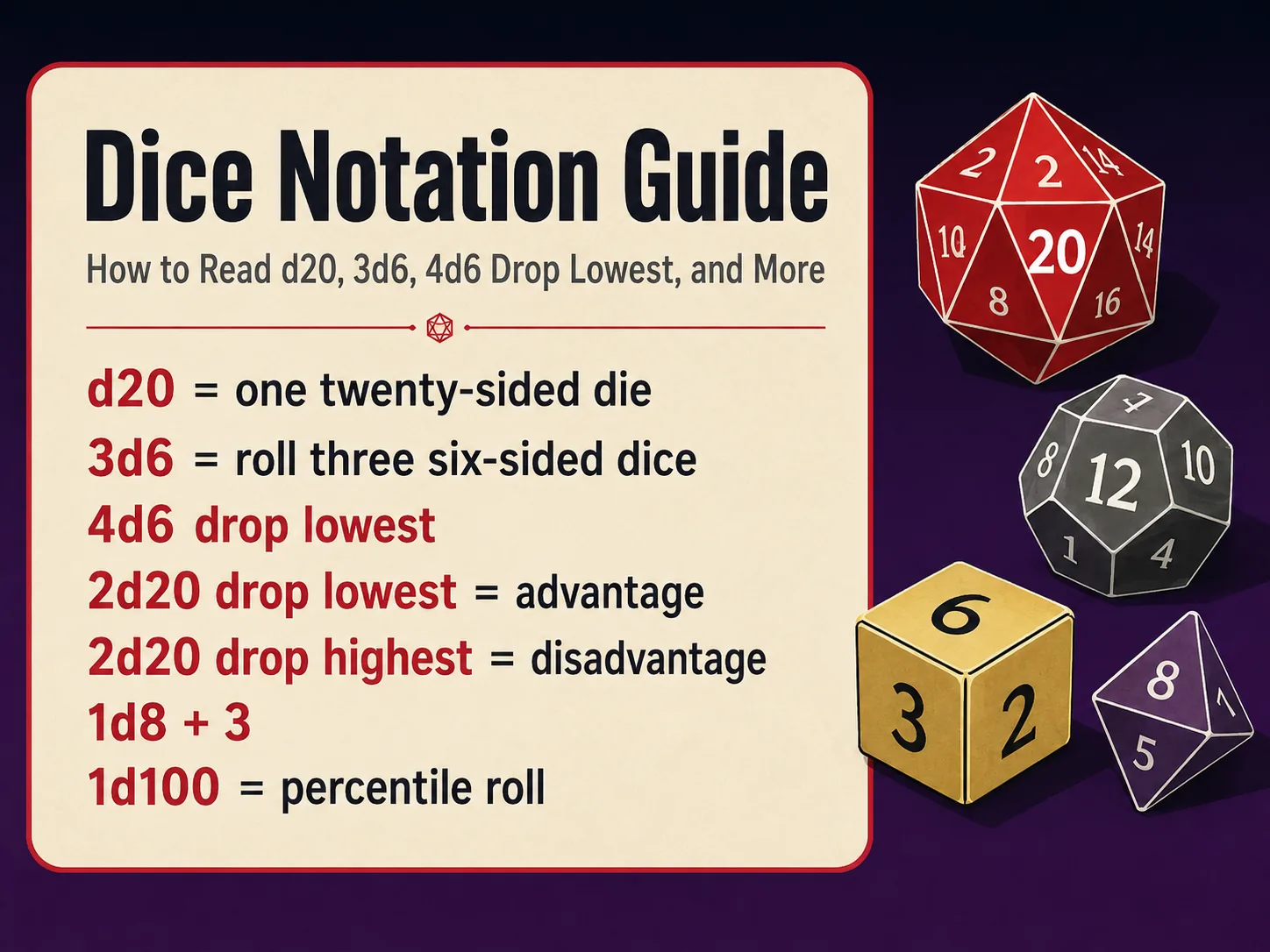
Preset: 2d20, drop lowest, + modifier
Advantage means rolling two d20s and keeping the higher. You get it when you attack a creature that can't see you, when an ally takes the Help action for you, or when a feature or spell says so [1, "Unseen Attackers and Targets"; "Help"].
Set a 2d20 line to Drop lowest 1 and add the modifier once, to the total. That last part matters: players roll twice, then forget the modifier or add it twice. A preset does it the same way every time.
What advantage is worth, by the number you need on the die:
| Need on the d20 | Normal | Advantage | Disadvantage |
|---|---|---|---|
| 5+ | 80% | 96% | 64% |
| 8+ | 65% | 88% | 42% |
| 11+ | 50% | 75% | 25% |
| 14+ | 35% | 58% | 12% |
| 16+ | 25% | 44% | 6% |
| 20 (crit) | 5% | 9.8% | 0.3% |
Advantage helps most in the middle: at 11+ it turns a coin flip into three in four. It nearly doubles your crit chance, which is why rogues and paladins chase it.
3. Disadvantage check
Preset: 2d20, drop highest, + modifier
Same line, set to Drop highest 1. You roll with disadvantage when you attack a target beyond your weapon's normal range, make a ranged attack with an enemy next to you, or attack something you can't see. The Blinded, Poisoned and Restrained conditions all impose it on your attack rolls [1, "Ranged Attacks"; "Rules Glossary"].
Read the right-hand column of the table above again. A roll you'd make half the time drops to one in four. A roll needing 16 lands 6% of the time. Show that number to the player who insists on firing a longbow (normal range 150 feet) at the dragon from 400.
4. Ability scores: 4d6 drop lowest
Preset: 4d6, drop lowest
The SRD's random method: roll four d6s, keep the highest three, do it six times [1, "Generate Your Scores"]. Set a 4d6 line to Drop lowest 1, duplicate it five times with ++, label them, and press ALL.
Roll 6, 5, 3, 1. Drop the 1. Score: 14.
Dropping one die lifts the average from 10.5 (straight 3d6) to 12.24. The gap shows most at the top:
| Score of at least | 4d6 drop lowest | 3d6 |
|---|---|---|
| 10 | 82.5% | 62.5% |
| 12 | 61.7% | 37.5% |
| 14 | 35.5% | 16.2% |
| 16 | 13.0% | 4.6% |
| 18 | 1.6% | 0.5% |
Across six rolls you have a 57% chance of at least one 16 or better, and a 49% chance of at least one 8 or worse. Randomness giveth. The preset also stops anyone adding all four dice by accident.
5. Weapon attack and damage pair
Preset: one attack line plus one damage line
Save your main attack as two lines with matching labels. Weapon dice are from the SRD 5.2.1 weapons table [1, "Weapons"].
| Weapon | Attack | Damage | Average damage |
|---|---|---|---|
| Longsword, +5 to hit, +3 damage | 1d20 + 5 | 1d8 + 3 | 7.5 |
| Greatsword, +6 to hit, +4 damage | 1d20 + 6 | 2d6 + 4 | 11 |
| Longbow, +7 to hit, +4 damage | 1d20 + 7 | 1d8 + 4 | 8.5 |
| Dagger, +6 to hit, +3 damage | 1d20 + 6 | 1d4 + 3 | 5.5 |
Save a third line for crits. On a Critical Hit you roll the attack's damage dice twice and add your modifier once [1, "Critical Hits"]. A greatsword crit is 4d6 + 4, not 4d6 + 8. Tables argue about this constantly; the preset settles it before the argument starts.
6. Spell damage
Preset: your spell's damage dice
Casters roll the same pile of dice every fight. Save the ones you cast most. Each spell links to its page here, with its dice at every slot level and the full odds chart.
| Spell | Damage (base slot) | Average |
|---|---|---|
| Fireball (3rd) | 8d6 | 28 |
| Lightning Bolt (3rd) | 8d6 | 28 |
| Magic Missile (1st), all darts at one target | 3d4 + 3 | 10.5 |
| Guiding Bolt (1st) | 4d6 | 14 |
| Inflict Wounds (1st) | 2d10 | 11 |
| Shatter (2nd) | 3d8 | 13.5 |
Figures from the SRD 5.2.1 spell descriptions [1, "Spells"]. Watch Inflict Wounds: the 2024 version is 2d10 with a Constitution save for half, not the old 3d10 melee spell attack.
For upcast spells, save one line per slot. Fireball adds 1d6 per slot level above 3rd:
- Fireball 3rd:
8d6(average 28) - Fireball 4th:
9d6(average 31.5) - Fireball 5th:
10d6(average 35)
If you split Magic Missile's darts between targets, save it as three d4s with +1 set to each instead of to total.
7. Healing potions
Preset: 2d4 + 2
| Potion of Healing | Rarity | Roll | Average | Range |
|---|---|---|---|---|
| Healing | Common | 2d4 + 2 | 7 | 4–10 |
| Greater | Uncommon | 4d4 + 4 | 14 | 8–20 |
| Superior | Rare | 8d4 + 8 | 28 | 16–40 |
| Supreme | Very Rare | 10d4 + 20 | 45 | 30–60 |
Source: SRD 5.2.1, "Potions of Healing" [1]. Potions come out when a character is one failed death save from a fresh character sheet. Nobody should be counting d4s at that moment, least of all the character drinking it.
8. Concentration check
Preset: 1d20 + Constitution save modifier
Take damage while concentrating and you make a Constitution save. The DC is 10 or half the damage taken (round down), whichever is higher, up to 30 [1, "Concentration"]. Any hit of 21 damage or less is a DC 10 save.
| Con save | vs DC 10 | vs DC 15 | DC 10 with advantage |
|---|---|---|---|
| +2 | 65% | 40% | 88% |
| +3 | 70% | 45% | 91% |
| +5 | 80% | 55% | 96% |
A wizard with +2 loses concentration on a third of ordinary hits. The DM must ask every time, and this preset makes asking cheap. If a feature gives you advantage on these saves, save the 2d20, drop lowest version too.
Fail to prepare your dice lines, prepare to fail your Constitution save.
9. Bonus damage dice
Preset: the extra dice only
Sneak Attack, smites and marks don't apply to every hit. Save the extra dice as their own line and roll them when they trigger.
| Feature | Bonus dice | Average |
|---|---|---|
| Sneak Attack, Rogue levels 1–2 | 1d6 | 3.5 |
| Sneak Attack, levels 3–4 | 2d6 | 7 |
| Sneak Attack, levels 5–6 | 3d6 | 10.5 |
| Sneak Attack, levels 9–10 | 5d6 | 17.5 |
| Divine Smite, 1st-level slot | 2d8 | 9 |
| Divine Smite vs a Fiend or Undead | 3d8 | 13.5 |
| Hunter's Mark | 1d6 | 3.5 |
| Hex | 1d6 | 3.5 |
Sneak Attack gains 1d6 every odd Rogue level [1, "Rogue"]. In the 2024 rules Divine Smite is a spell: 2d8 radiant, 1d8 more per slot level above 1st, and 1d8 more against Fiends and Undead [1, "Spells"].
These dice double on a crit too [1, "Critical Hits"]. A level 5 rogue's Sneak Attack crit rolls 6d6. Save that line. You'll want it once a session, and you'll want it fast.
10. Random tables
Preset: 1d100, plus the small dice
| Table size | Roll |
|---|---|
| Percentile | 1d100 |
| Short list | 1d6 |
| Medium list | 1d12 |
| Long list | 1d20 |
Random tables aren't just for treasure. Tavern rumours, wilderness encounters, NPC moods, odd dungeon details, travel complications: write six to twenty entries, save the matching die, and let the table improvise for you.
Starter list for players
- Main attack.
- Main damage.
- Main attack with advantage.
- Main damage on a crit.
- Concentration, or your most common save.
- Your most common spell or bonus damage.
Starter list for DMs
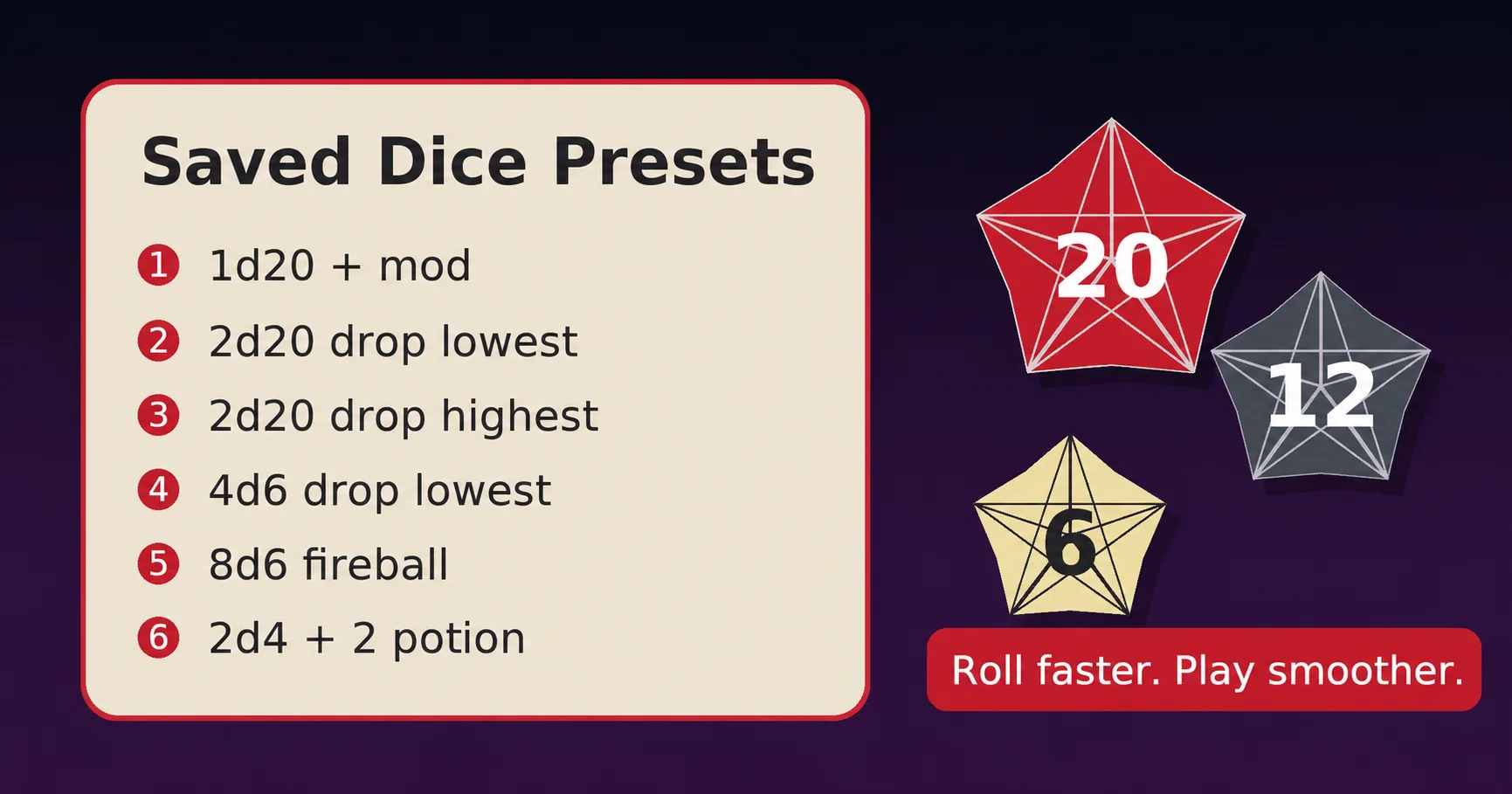
1d20for quick checks and monster rolls.2d20 drop lowestfor advantage.2d20 drop highestfor disadvantage.1d100for tables.- A few damage pools:
2d6,3d6,4d8,8d6.
You don't need a preset for every monster. Each monster page here already rolls its hit points, attacks and multiattack.
Name them so you can read them in six weeks
Bad labels: Big hit. Magic thing. Steve roll. Panic button.
Good labels: Longbow +7. Longbow dmg 1d8+4. Stealth adv +6. Fireball 8d6. Concentration +3. Crit greatsword 4d6+4.
"Steve roll" made sense to someone once. It no longer does, and Steve left the campaign.
Ten minutes before the session
Presets don't replace knowing the rules. They remove the setup, so the table stays on the game. Build attack, damage, advantage, crit and concentration before you sit down, and add spells and tables as you need them. Want to watch them tumble? The same rolls play out on the 3D table.
Table Talk
Rohan: Ten presets is too many. Attack, damage, crit. Done.
Arthur: And when the wizard takes an arrow? At +2 they lose concentration on a third of ordinary hits.
Rohan: Then the wizard saves a fourth. Still not ten.
Arthur: Fine. But label them. "Steve roll" is not a label.
Rohan: Neither is "Big hit". Mine say the weapon and the bonus. Longbow +7.
Arthur: Good. Now the crit line. Greatsword crit is 4d6 + 4, not 4d6 + 8.
Rohan: Tables argue about that constantly.
Arthur: Which is why the preset settles it first. Build them ten minutes before the session, not in round one.
Rohan: Round one is when the DM reads the monster. Plenty of time.
Arthur: That is how you end up with a line called "Panic button".
References
- Wizards of the Coast. (2025). System Reference Document 5.2.1 (SRD 5.2.1), sections "Playing the Game", "Character Creation", "Classes: Rogue", "Equipment: Weapons", "Spells", "Magic Items: Potions of Healing" and "Rules Glossary". CC-BY-4.0. https://www.dndbeyond.com/srd