In January 1974, a small Wisconsin company shipped three booklets in a woodgrain cardboard box. The whole print run was 1,000 copies, assembled by hand, and it took eleven months to sell out [1]. Since then Dungeons & Dragons has had more makeovers than a polymorphed wizard, and every edition has partisans ready to tell you theirs was the real one.
Rather than crown a champion, here is what each edition does better than the others, with the dates checked and the rules quoted.
The Family Tree at a Glance
| Edition | Year | Lead designer(s) | Its one-line virtue |
|---|---|---|---|
| Original D&D | 1974 | Gary Gygax, Dave Arneson | Imagination does the heavy lifting |
| AD&D 1st Edition | 1977–1979 | Gary Gygax | Voice, danger, legendary modules |
| AD&D 2nd Edition | 1989 | David "Zeb" Cook | Campaign settings |
| D&D 3rd Edition / 3.5 | 2000 / 2003 | Jonathan Tweet, Monte Cook, Skip Williams | One core mechanic, deep builds, the OGL |
| D&D 4th Edition | 2008 | Rob Heinsoo | Balance and encounter design |
| D&D 5th Edition | 2014 | Mike Mearls | Easiest way in |
| D&D 2024 ("5.5") | 2024 | — | 5E with the rough edges sanded |
Dates and designers from Jon Peterson's official timeline [1], except 2024, from the SRD 5.2.1 [5].
Original D&D (1974): The Little Brown Books
Three digest booklets: Men & Magic, Monsters & Treasure and Underworld & Wilderness Adventures [1]. The famous white box only arrived with the fourth printing, 5,000 copies, in 1976 [1]. Dice weren't included in a D&D box until the 1977 Basic Set, and in 1979 supply shortages meant some Basic Sets shipped with cardboard chits instead [1]. Imagine explaining that to a d20 collector.
Virtues
- Pure imagination. The rules are thin on purpose. You and your referee fill the gaps, and filling gaps is how the hobby was born.
- Fast characters. Roll 3d6 down the line, pick one of three classes, name your fighter, go.
- The original sandbox. Dungeon levels, wilderness hexes, wandering monsters: "go explore the unknown" at its purest.
- Historical weight. It grew out of Chainmail (1971) and Arneson's Blackmoor campaign [1]. Reading it now feels like reading the Dead Sea Scrolls of nerd culture.
If you want the raw DNA of the hobby, start here.
AD&D 1st Edition (1977–1979): Gygax's Magnum Opus
Three hardcovers: the Monster Manual (1977, 350 monsters), the Players Handbook (1978) and the Dungeon Masters Guide (1979) [1]. This is the edition that put D&D on the map, and in front of worried parents: by 1981 the novel and TV film Mazes and Monsters were feeding the panic [2].
Virtues
- Voice. Gygax wrote like a thesaurus on a quest. Every page has personality, weird tables and digressions on polearms nobody asked for.
- Tournament-grade adventures. The giant-slaying G1–G3 and the drow-haunted D1–D3 began as 1978 convention tournaments, and Tomb of Horrors started at Origins I in 1975 [1]. Many of the all-time great modules come from here.
- High stakes. A 1st-level magic-user has a d4 for hit points and one spell a day. Survival is a verb.
If your idea of D&D is "the dungeon is trying to kill you, and that's the point", 1e is yours.
AD&D 2nd Edition (1989): The Storyteller's Edition
Released in 1989 under lead designer David "Zeb" Cook, with the Complete Fighter's Handbook and Complete Thief's Handbook out the same year [1]. It cleaned up 1e and cut what had drawn fire: the assassin and the half-orc went, and demons and devils were renamed tanar'ri and baatezu [3]. TSR had received roughly a letter a week about demons since the first Monster Manual; James M. Ward called the policy "Avoiding the Angry Mother Syndrome" [3].
Virtues
- Settings, settings, settings. Ravenloft (1990), Dark Sun (1991), Al-Qadim (1992), Planescape (1994), Birthright (1995), on top of the Forgotten Realms (1987) [1]. No edition built more worlds.
- Kits. The Complete handbooks let you customise a class without the bolt-on sprawl of later editions.
- Story-first play. The long-running campaign, the world with history, the villain with a castle: Strahd von Zarovich came to his own setting in 1990 [1].
If you love worldbuilding and lived-in fantasy, 2e set the standard everyone still copies.
D&D 3rd Edition / 3.5 (2000–2008): The d20 Revolution
Wizards of the Coast bought TSR in 1997 and released Third Edition in 2000, dropping "Advanced" from the name [1]. Roll a d20, add a modifier, beat a target number. Done.
Virtues
- One core mechanic. Attacks, saves, skills and checks all use the same maths. After decades of subsystems, a revelation.
- The Open Game License. Published alongside a System Reference Document, it let other companies build on the rules, and, in the timeline's words, "the industry is transformed" [1]. Wizards still publishes a free SRD for the current rules [5].
- Build freedom. Multiclassing, prestige classes, feats, skill points. Build the character you actually want. (Then spend three sessions explaining it to the DM.)
- Tactical depth. Battle grids, attacks of opportunity, flanking and the 5-foot step gave combat a chess flavour. The 3.5 revision followed in 2003, the same year as the D&D Miniatures Game [1].
If you love crunchy builds and tactical combat, nothing scratches that itch like 3.5.
D&D 4th Edition (2008–2014): The Tactical Skirmish
The most argued-about edition, led by Rob Heinsoo, with its own Game System License for third parties [1]. Loved, loathed, and more influential than people admit.
Virtues
- Balance. Every class runs on the same at-will, encounter and daily powers, so no class sits out a fight.
- Fighters get moves. Martial characters got named, repeatable manoeuvres instead of "I attack again".
- Encounter design. Monster roles (brute, soldier, artillery, skirmisher, lurker, controller) and one-hit minions made building a good fight easy for the DM.
- Skill challenges. A framework for non-combat drama: rack up successes before failures. Imperfect, but it tried.
If you want a tight, balanced tactical game with cinematic abilities, 4e is unfairly maligned. Try it again.
D&D 5th Edition (2014–2024): The Crowd Pleaser
Released in 2014 under lead designer Mike Mearls, starting with a free online Basic Rules [1]. The version that took D&D from the basement to everywhere.
Virtues
- Approachable. The gentlest learning curve D&D has had.
- Small numbers. Proficiency bonus runs from +2 to +6 across twenty levels [4], so a crowd of goblins still worries a high-level party.
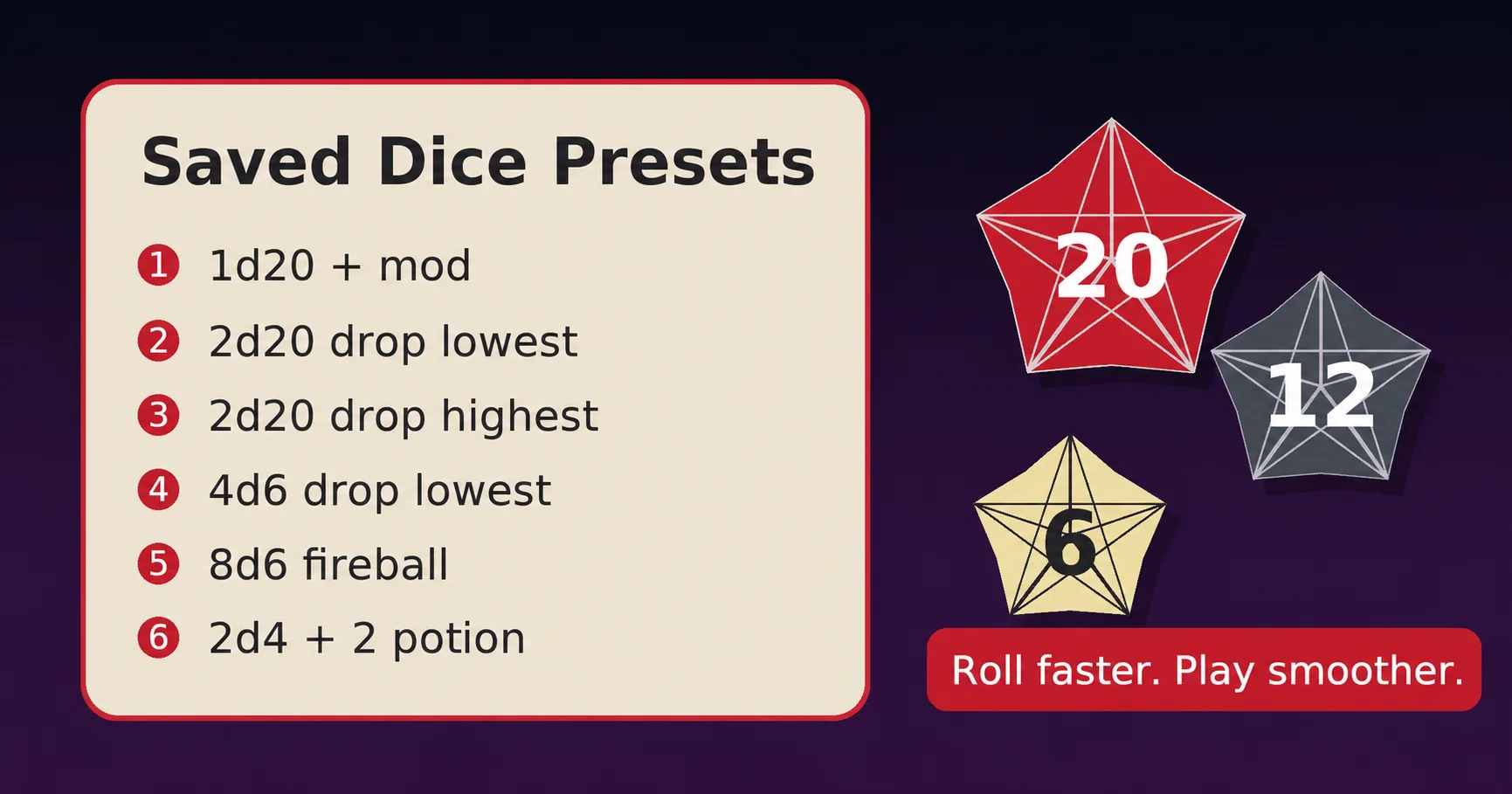
- Advantage and Disadvantage. Roll two d20s, use the higher (or the lower) [4]. One rule replaces a pile of fiddly +2s and −2s. Advantage lifts a coin-flip roll from 50% to 75%; our dice notation guide has the full table.
- Roleplay prompts. Backgrounds suggest personality traits, ideals, bonds and flaws [4], small nudges toward characterful play.
If the goal is "five friends rolling dice on a Friday night", 5e is the most frictionless version ever printed.
D&D 2024 ("5.5"): The Director's Cut
The 2024 rules keep 5e's core and revise it; the SRD 5.2.1 carries the new text under CC-BY-4.0 [5]. Compare a few rules side by side:
| Rule | 2014 (SRD 5.1) | 2024 (SRD 5.2.1) |
|---|---|---|
| Surprise | Can't move or act on your first turn [4] | Disadvantage on your Initiative roll [5] |
| Great Weapon Fighting | Reroll 1s and 2s on damage dice [4] | Treat 1s and 2s as 3s [5] |
| Ability score bonuses | From your race [4] | From your background, which also grants an Origin feat [5] |
| True Strike | Advantage on your next attack [4] | A cantrip weapon attack using your spellcasting ability [5] |
Virtues
- Weapon Mastery. Barbarians, fighters, paladins, rangers and rogues unlock properties like Graze and Sap that give weapons a real identity [5].
- Backgrounds matter. Your history sets your ability increases (+2/+1 or +1/+1/+1) and a starting feat [5].
- Cleaner conditions. Exhaustion is one line: each level is −2 to every D20 Test and −5 feet of Speed [5].
- Spell repairs. Conjure Animals now summons a single spectral pack instead of a stat-block avalanche [5].
If you love 5e and wished someone would do a careful second pass, this is it.
So Which Edition Is Best?
The one your group actually plays.
Every edition rewrote the rules. Not one of them fixed what happens when you roll a 1.
| You want... | Play |
|---|---|
| Dangerous, exploratory dungeon crawls | OD&D, 1e, or an OSR game |
| Deep settings and long campaigns | 2e |
| Maximum build freedom | 3.5 |
| Balanced tactical fights | 4e |
| Easy onboarding, Friday-night fun | 5e |
| The same, with fresh paint | 2024 |
The Strong National Museum of Play inducted Dungeons & Dragons into its National Toy Hall of Fame in 2016 [6]. Fifty years on, the game's greatest virtue isn't any one edition. It's that there is an edition for every kind of table.
Grab some dice, or the 3D roller. Roll for initiative. The dungeon doesn't run itself.
Table Talk
Tia: Why does every edition have people ready to fight for it? Is it the rules they defend, or the table they started at?
Arthur: Some of it is rules. 4e gave every class at-will, encounter and daily powers, so nobody sits out a fight. It's still the most argued-about edition.
Tia: So balance isn't what players want.
Arthur: It's what the DM wants. Monster roles, minions. Building a fight gets easy.
Tia: 2e is the one I'd study. A letter a week about demons, so TSR renamed them. A moral panic, answered with a thesaurus.
Arthur: For the record: tanar'ri were the demons, baatezu the devils.
Tia: Noted. Tip for any table: ask what everyone wants from a night first, then pick the edition.
Arthur: And if nobody agrees, 2024. 5e with the rough edges sanded.
Tia: The diplomatic edition.
References
- Peterson, Jon. "History: Forty Years of Adventure." Wizards of the Coast, 2014. Archived: https://web.archive.org/web/2019/http://dnd.wizards.com/dungeons-and-dragons/what-dd/history/history-forty-years-adventure
- The Strong National Museum of Play. "Dungeons & Dragons: The First 50 Years of Storytelling." Google Arts & Culture. https://artsandculture.google.com/story/dungeons-amp-dragons-the-first-50-years-of-storytelling-the-strong/jwUhqeUB49cvBg
- Tresca, Michael "Talien". "Blowing it All Up and Starting Over." EN World, 1 January 2018. https://www.enworld.org/threads/blowing-it-all-up-and-starting-over.664990/
- Wizards of the Coast. System Reference Document 5.1: "Combat" (Surprise), "Using Ability Scores" (Advantage and Disadvantage), "Classes" (proficiency bonus; Fighting Style), "Races" (Ability Score Increase), "Backgrounds" (Acolyte), "Spells" (True Strike). CC-BY-4.0 release, 2023. https://media.wizards.com/2023/downloads/dnd/SRD_CC_v5.1.pdf
- Wizards of the Coast. System Reference Document 5.2.1: "Playing the Game" (Surprise), "Character Origins" (Backgrounds), "Feats" (Great Weapon Fighting), "Equipment" (Weapon Mastery), "Spells" (True Strike, Conjure Animals), "Rules Glossary" (Exhaustion). 2025. CC-BY-4.0. https://www.dndbeyond.com/srd
- The Strong National Museum of Play. "Dungeons & Dragons." National Toy Hall of Fame, inducted 2016. https://www.museumofplay.org/toys/dungeons-dragons/